Every 13 minutes, someone in Canada experiences a cardiac arrest. That is approximately 40,000 cases per year, according to the Heart and Stroke Foundation. Knowing how to respond during these critical moments makes the difference between life and death. The first step is choosing the right training. Here, you’ve two options- BLS vs CPR C.
The terms are often used interchangeably. But there are important differences between the two. What are these differences? And who should take which one? Let’s discuss.ÂÂ
Main Difference Between CPR Level C Vs BLR

The main difference between BLS and CPR is that BLS is more advanced. It is a healthcare-level training. On the other hand, CPR is designed for the general public. It is required for workplace training.
Confused between CPR C vs BLS? Let’s break it down.
What is CPR?
CPR stands for Cardiopulmonary Resuscitation. This is an emergency technique used to keep blood and oxygen flowing in a person who has stopped breathing. It is also used on people whose heart has stopped.ÂÂ
In CPR, the common training is chest compressions and rescue breaths. This is mostly performed by laypersons and professionals. CPR involves chest compressions and rescue breaths and can be performed by laypersons and professionals alike.
CPR Level C is among the many levels of CPR, but it is also the most common. It includes:
- Adult, child, and infant CPR
- Choking response
- Use of an Automated External Defibrillator (AED)
- Two-rescuer CPR techniques
Between BLS VS CPR Level C, take CPR C if you’re a teacher, childcare worker, or fitness instructor. It is also applicable to general workplace requirements.

What is BLS?
BLS (Basic Life Support) is a more in-depth form of CPR training. BLS course is mainly for healthcare professionals such as doctors, nurses, paramedics, and hospital staff. It includes everything in CPR training, and:
- High-quality chest compressions.
- Bag-valve-mask (BVM) use.
- Advanced team-based resuscitation.
- Managing cardiac arrest in clinical settings.
BLS vs. CPR: Quick Comparison Table
Here’s a simple side-by-side comparison to help you see the differences more clearly:
| Feature | CPR Level C | BLS (Basic Life Support) |
| Intended Audience | General public, workplace | Healthcare professionals |
| Skills Covered | Adult, child, infant CPR, AED, choking | CPR + BVM use, team dynamics, clinical focus |
| Course Duration (avg.) | 4–5 hours | 4–6 hours |
| Certification Validity | 3 years (varies) | 1 year (standard for healthcare workers) |
| Focus | Individual response | Team response and professional settings |
| Includes AED Training? | Yes | Yes |
| Bag-Valve-Mask Use? | No | Yes |
| Commonly Required For | Childcare, schools, fitness centres | Hospitals, clinics, dental offices |
Who Should Consider Which Course?ÂÂ
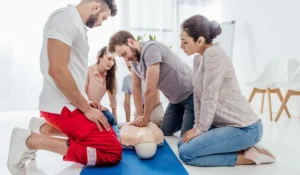
If you wish to help family, friends or anyone you know in an emergency, you should train for CPR C. It can be a great starting point.ÂÂ
Between CPR class C vs BLS, the former allows you to increase a victim’s chances of survival by 2, and in some cases, 3 times. Only 50% of out-of-hospital cardiac arrests currently receive bystander CPR. And you can be the one to decrease this number.ÂÂ
On the other hand, if you are a healthcare professional, first responder, or caregiver for someone with medical conditions, BLS is the recommended certification.
85% of hospitals require BLS certification for their clinical staff. So, if you’re in the medical field, you should choose to get training in BLS.
Choose CPR Level C If:
- You work with children (e.g., daycare, schools).
- You need certification for a workplace safety requirement.
- You’re a parent, coach, or someone who wants to be prepared.
- You’re not in the healthcare field, but still want life-saving skills.
Choose BLS If:
- You’re a medical or nursing student.
- You work in a hospital, clinic, or dental office.
- You are a first responder or emergency worker.
- Your employer or licensing body requires advanced CPR training.

Make Your Final Decision
Still unsure which to choose from CPR BLS VS CPR C​? Ask yourself this:
Am I in a healthcare-related role or pursuing one? Choose BLS.
Do I just want to be prepared for emergencies at work or at home? Choose CPR Level C.
Remember, there’s no wrong choice when it comes to choosing BLS vs CPR C. You can help save lives by learning both. The difference is important if you need a specific job or you’re in healthcare.
Whether you need CPR Level C for work or want to take your training to the next level with BLS, Primary Care First Aid has you covered. We offer trusted, high-quality training for individuals, workplaces, and healthcare professionals. For any kind of query, make sure to reach out to us.ÂÂ
