Renewing your RMT registration comes with a long checklist, and first aid is one line that trips up even experienced practitioners. Maybe you are wondering exactly which certification level counts, whether your course earns you any CEUs, or if any first aid provider will do. This guide walks through the College of Massage Therapists of BC’s actual bylaw wording, names the approved providers, and clears up the CEU question once and for all. By the end, you will know exactly what to book and how it fits into your yearly renewal.
CMTBC requires all Registered Massage Therapists in BC to hold current Standard First Aid with CPR-C, under Bylaw Section 63.3(1). The certificate must come from one of five named national organizations. As of 2024, CMTBC no longer uses a CEU system; instead, your continuing education is tracked through the Practice Development Program (PDP), and first aid is a separate, mandatory registration requirement, not a PDP learning activity.
That last point catches a lot of RMTs off guard, so let’s break down exactly why the old CEU model does not apply anymore.

Who Is CMTBC and Why This Rule Exists
The College of Massage Therapists of British Columbia is the regulatory body that oversees Registered Massage Therapists across the province. It sets the standards for registration, ongoing education, and professional conduct, all with the goal of protecting patients during treatment.
Massage therapy involves close physical contact and sessions that can run 30 to 90 minutes with a patient lying down, sometimes alone with the practitioner. A client can faint, have an allergic reaction, or experience a cardiac event during a routine session. Because of this real risk, CMTBC treats first aid certification as a non-negotiable part of practising safely, not just a box to check once at registration.
The Exact Requirement: Standard First Aid with CPR-C
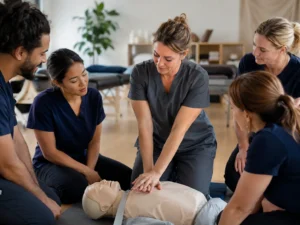
CMTBC’s Bylaw Section 63.3(1) states that RMTs must maintain current certification in Standard First Aid and CPR-C. This is a specific, named level, not a general first aid course. Standard First Aid is a more advanced program than Emergency First Aid, and CPR-C covers resuscitation for adults, children, and infants, along with AED use.
A basic layperson CPR course or a short Emergency First Aid class does not meet this standard. If your certificate does not specifically say Standard First Aid with CPR-C, or an equivalent recognized by CMTBC, it will not satisfy your registration requirement.
Which Providers Does CMTBC Accept?
CMTBC does not accept a certificate from just any training company. The bylaw names five national organizations whose Standard First Aid and CPR-C programs are recognized as substantially equivalent:
- Canadian Red Cross
- Canadian Ski Patrol
- Heart and Stroke Foundation
- Lifesaving Society
- St. John Ambulance
These five organizations follow the same Canadian Consensus Guidelines on First Aid and CPR, published by a national task force in 2016. This means the training content is standardized across providers, so you can choose based on convenience or schedule rather than worrying about which one CMTBC prefers. Before you enroll, it is worth double-checking that the specific course leads to a certificate from one of these five organizations, since some training companies operate under a different name locally.
Standard First Aid vs. Emergency First Aid: Why the Level Matters
| Feature | Standard First Aid with CPR-C | Emergency First Aid |
| Accepted by CMTBC | Yes | No |
| Course length | Typically 2 days | Typically 1 day |
| CPR level included | CPR-C (adult, child, infant) | Often CPR-A or B |
| Scope of injuries covered | Comprehensive, including spinal and head injuries | Basic response only |
| Certificate validity | 3 years | 3 years |
The extra content in Standard First Aid, including spinal injury management and a wider range of medical emergencies, reflects the kind of situations an RMT could realistically face during a private treatment session. This is why CMTBC sets the bar at Standard First Aid rather than the shorter Emergency First Aid course.
Do You Get CEUs for a First Aid Course?
This is where a lot of outdated information causes confusion. Under CMTBC’s old continuing education model, RMTs earned Continuing Education Credits, or CECs, for approved courses. That system has since changed.
Since January 2024, CMTBC uses the Practice Development Program (PDP) instead of a CEU or CEC point system. Practising RMTs must complete two registrant-directed learning activities each year, spread across seven core competency categories: Communication, Equity Diversity and Inclusion, Indigenous Cultural Safety, Treatment, Knowledge Growth, Professional Obligations, and Patient Care.
Your Standard First Aid with CPR-C certificate is tracked as a separate, mandatory registration requirement, not as one of your two PDP learning activities. In other words, you do not earn a specific number of CEUs for taking it, because CMTBC no longer issues CEUs at all. If you are unsure whether your specific course can be logged in your PDP Portal for any additional credit, it is worth confirming directly with CMTBC, since individual interpretations can vary year to year.
How Often Do You Need to Renew?
Standard First Aid with CPR-C certificates from the five recognized providers are typically valid for three years. However, CMTBC’s registration renewal happens every year, so your certificate needs to stay current at all times, not just at your three-year mark.
Practically, this means you should track your first aid expiry date separately from your annual registration date. If your certificate lapses partway through a registration year, you are technically out of compliance with Bylaw 63.3(1) until you recertify, even if your CMTBC registration itself is still active. Our guide on maintaining your first aid and BLS certification offers a simple way to track multiple expiry dates so nothing slips through the cracks.
What a Compliant Course Must Include
A CMTBC-accepted Standard First Aid with CPR-C course should include:
- A hands-on, in-person skills evaluation, not a fully self-paced online format
- CPR training for adults, children, and infants
- AED training
- Coverage of spinal, head, and soft tissue injuries
- A certificate from one of the five approved national organizations
If you took a course years ago under a different name, such as an older “Intermediate First Aid” label, check with the provider or CMTBC to confirm it still counts as equivalent under the current bylaw wording.
Where to Get Standard First Aid with CPR-C in BC
Since this is a named requirement, it makes sense to book directly with a recognized provider rather than guessing whether a course qualifies. At Primary Care First Aid, we run Standard First Aid with CPR/AED Level C courses across Vancouver and Surrey through the Canadian Red Cross, one of CMTBC’s five approved organizations. Every class includes the full hands-on skills assessment CMTBC expects, so your certificate is ready to upload the moment you finish.
Frequently Asked Questions
What level of first aid does CMTBC require for RMTs?
CMTBC requires Standard First Aid with CPR-C, under Bylaw Section 63.3(1). This must come from one of five approved national organizations: Canadian Red Cross, Canadian Ski Patrol, Heart and Stroke Foundation, Lifesaving Society, or St. John Ambulance.
How many CEUs do RMTs get for a first aid course?
None, under the current system. CMTBC replaced its old CEU and CEC model with the Practice Development Program in 2024. First aid is tracked as a separate mandatory registration requirement, not as a PDP learning activity.
How long is a Standard First Aid with CPR-C certificate valid?
Certificates from CMTBC’s approved providers are typically valid for three years. Your certificate must stay current throughout your entire registration period, so track its expiry date separately from your annual CMTBC renewal.
Can I take an online-only first aid course to meet CMTBC’s requirement?
No. CMTBC expects a hands-on, in-person skills component as part of your Standard First Aid with CPR-C training. A fully self-paced online course without a live practical assessment will not satisfy the requirement.
Does CMTBC accept CPR-A or CPR-B instead of CPR-C?
No. The bylaw specifically names CPR-C, which covers adult, child, and infant resuscitation. Lower CPR levels do not meet the requirement, even if paired with a Standard First Aid certificate.
Renewal Made Simple, Not Stressful
Keeping your Standard First Aid with CPR-C current does not need to feel like another bureaucratic hurdle buried in your CMTBC paperwork. Once you know the exact level, the five approved providers, and the fact that it sits outside your PDP learning activities, the requirement becomes a simple item to schedule rather than a source of last-minute stress.
Book your Standard First Aid with CPR-C course a few weeks before your current certificate expires, and you will stay compliant with CMTBC’s bylaw without any gaps in your ability to practise.
