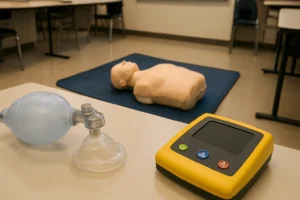
BVM stands for Bag-Valve-Mask. It is a handheld device that helps a trained rescuer give breaths to someone who is not breathing normally.
A BVM is often used by healthcare professionals and emergency responders. It is also called a bag-mask device.
What Is a Bag-Valve-Mask?
A BVM has three main parts:
| Part | Purpose |
|---|---|
| Bag | Pushes air toward the person’s lungs when squeezed |
| Valve | Helps direct airflow |
| Mask | Fits over the person’s nose and mouth |
Some BVM systems can also connect to an oxygen supply. The device does not perform chest compressions or deliver an electric shock.
To understand the difference between rescue breathing and basic CPR, read Is Basic Life Support the Same as CPR?.
When Is a BVM Used?
A trained responder may use a BVM when someone needs assisted breathing. Examples include:
- Cardiac arrest during professional resuscitation.
- Respiratory arrest.
- Serious breathing emergencies.
- Emergency care before advanced medical support arrives.
BVM use requires proper training. The mask must fit well, the airway must stay open, and breaths must be delivered at the correct rate.
People deciding between different courses can read our BLS vs CPR Level C guide.
How Does BVM Ventilation Work?
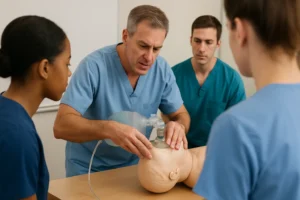
During a professional emergency response, trained rescuers may:
- Position the patient and open the airway.
- Place the correct-size mask over the nose and mouth.
- Create a secure seal.
- Deliver breaths by squeezing the bag.
- Watch for visible chest rise.
- Reassess breathing and follow the appropriate resuscitation protocol.
The American Heart Association notes that bag-mask ventilation works best with two trained rescuers because maintaining a good seal can be difficult.
This is not a skill to learn from written instructions alone. Incorrect ventilation can be ineffective or cause harm.
BVM vs CPR vs AED
These tools and techniques have different purposes.
| Technique or device | Main function |
|---|---|
| CPR | Supports circulation, with rescue breaths when appropriate |
| BVM | Helps deliver assisted breaths |
| AED | Analyzes heart rhythm and may deliver a shock |
For general CPR and AED skills, explore CPR/AED Level C training.
Who Should Learn BVM Skills?
BVM skills may be relevant to:
- Healthcare workers.
- Emergency medical responders.
- First responders.
- Nursing and healthcare students.
- Professional rescue teams.
Students should check their program’s requirements. Our nursing student CPR guide can help with course selection.
Those pursuing professional training may also benefit from understanding BLS course applications.
Frequently Asked Questions
Is BVM the same as an oxygen mask?
No. A BVM provides assisted breaths. A regular oxygen mask delivers supplemental oxygen to a person who is breathing.
Can one person use a BVM?
A trained rescuer may use a BVM alone, but two trained rescuers generally provide more effective bag-mask ventilation.
Is BVM training included in every CPR course?
No. Course content varies. Confirm whether BVM practice is included or requires additional airway-management training.
Learn Professional CPR and Breathing Skills
Primary Care First Aid offers CPR training for individuals and healthcare professionals in British Columbia.
If your work requires assisted ventilation skills, review the Basic Life Support course and ask whether the airway-management option meets your needs.
