When you come across an emergency, your heart starts to race. You want to help, but you might not know where to start. In the world of first aid, we use acronyms to help us remember exactly what to look for. One of the most important ones is DOTS.
If you are taking a Standard First Aid course or preparing for an Occupational First Aid Level 1 exam, you need to know this acronym by heart.
In this guide, we will break down what DOTS stands for, when to use it, and why it is a life-saving tool for every first aider.
What is the DOTS Acronym?
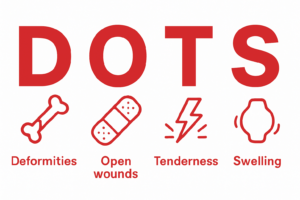
In first aid, DOTS is a memory aid used to look for signs of a physical injury during a “head-to-toe” exam. It stands for:
- D – Deformities
- O – Open Wounds
- T – Tenderness
- S – Swelling
A Deep Dive into DOTS
To be an effective first aider, you need to understand exactly what you are looking for when you check a patient. Let’s break down each letter of the DOTS acronym.
D – Deformities
A deformity is when a part of the body looks “wrong” or misshapen. This often happens with broken bones or dislocated joints.
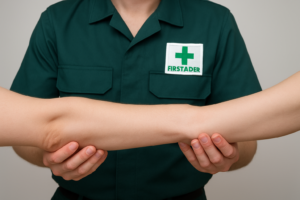
- How to check: Compare one side of the body to the other. For example, if you think a person’s left arm is broken, look at their right arm. Does the left one have a strange bump or a bend where it shouldn’t be?
- What it means: A deformity almost always points to a significant injury like a fracture.
O – Open Wounds
An open wound is any break in the skin. This could be a small scrape or a deep cut.
- How to check: Look for blood or wetness on the clothing. Sometimes, you may need to carefully move clothing aside to see the skin.
- What it means: Open wounds need to be cleaned and bandaged to prevent infection. In serious cases, they need immediate pressure to stop heavy bleeding. For more on this, see our guide on first aid for common injuries.
T – Tenderness
Tenderness is a medical word for “pain when touched.” A patient might feel fine while lying still, but as soon as you gently press on an area, they feel sharp pain.
- How to check: Gently feel (or “palpate”) the area. Watch the patient’s face. If they wince, pull away, or moan, that area is tender.
- What it means: Tenderness tells you that there is an internal injury, even if you can’t see a bruise or a cut yet.
S – Swelling
Swelling happens when fluid builds up in the body’s tissues after an injury. It often makes the skin look tight, shiny, or puffy.
- How to check: Look for areas that seem larger than normal. Swelling usually happens around sprained ankles, bee stings, or broken bones.
- What it means: Swelling is the body’s way of protecting itself, but it can also be very painful. It is often treated with the RICER method.
When Do You Use DOTS?
In a first aid emergency, you don’t start with DOTS. There is a specific order of operations you must follow.
- Check the Scene: Make sure it is safe for you to help.
- Primary Survey (The ABCs): Check the ABCs of first aid (Airway, Breathing, and Circulation). If the person isn’t breathing, you start CPR immediately.
- Secondary Survey: If the person is breathing and stable, you move on to the Secondary Survey. This is when you use DOTS.
The Secondary Survey is a “head-to-toe” check. You start at the head and work your way down to the toes, looking for Deformities, Open wounds, Tenderness, and Swelling at every step.
DOTS vs. SAMPLE: What’s the Difference?
Many students get DOTS confused with another acronym: SAMPLE. Here is the easy way to remember the difference:
- DOTS is for what YOU see and feel. It is a physical exam of the body.
- SAMPLE is for what THEY tell you. It is a medical history. You ask questions about their Sample First Aid Acronym (Signs/Symptoms, Allergies, Medications, etc.).
A good first aider uses both. You use DOTS to find the physical injuries, and you use SAMPLE to understand the person’s medical background.
DOTS vs. DCAP-BTLS
If you are moving into more advanced training, like Occupational First Aid Level 2, you might hear the term DCAP-BTLS.
DCAP-BTLS is just a more detailed version of DOTS. While DOTS is great for the general public and basic workplace safety, DCAP-BTLS is used by paramedics and advanced first aiders to look for specific things like “crepitus” (grinding bones) or “penetrations.”
If you want to learn the advanced version, read our full post on DCAP-BTLS first aid assessment.
Why Every Workplace in BC Needs to Know DOTS
WorkSafeBC requires employers to have trained first aiders on-site. When an accident happens at work like a slip, a fall, or a tool injury, the first responder needs to be able to give a clear report to the paramedics when they arrive.
By using DOTS, you can give a professional report. Instead of saying, “His leg looks bad,” you can say, “I found swelling and tenderness on the left lower leg, but no open wounds or deformities.”
This clear communication helps the medical team work faster and can lead to a better recovery for the injured worker. Knowing these essential first aid acronyms makes you a more valuable employee.
How to Practice the DOTS Method
You don’t have to wait for an emergency to practice. You can practice on a friend or family member (with their permission!).
- Start at the Head: Look for bumps (Tenderness/Swelling) or cuts (Open Wounds).
- Check the Neck and Shoulders: Feel for any pain.
- Check the Chest and Abdomen: Look for bruising or pain when they take a breath.
- Check the Arms and Legs: Look for any strange angles (Deformities).
- Check the Hands and Feet: Can they wiggle their fingers and toes?
Knowledge is Power
The DOTS acronym is a simple but powerful tool. It turns a chaotic situation into a structured, step-by-step process. By looking for Deformities, Open wounds, Tenderness, and Swelling, you ensure that no injury goes unnoticed.
Whether you are a parent looking out for your kids or a worker trying to keep your job site safe, getting certified is the best way to master these skills.
Are you ready to get your certification?
We offer a variety of courses throughout the Lower Mainland. Whether you need a first aid course in Vancouver or a first aid course in Surrey, Primary Care First Aid is here to help.
Don’t wait for an emergency to happen. Book your course today!
Frequently Asked Questions About DOTS
Is DOTS used in CPR?
No. DOTS is used for physical injuries (trauma) during the secondary survey. If a person is not breathing, you should follow CPR and AED training procedures instead.
What is the most important part of DOTS?
All parts are important, but “Deformities” and “Open Wounds” are often the most urgent because they point to broken bones or major bleeding.
Do I need a certificate to use DOTS?
Anyone can use DOTS to help someone, but taking a Basic First Aid course will give you the hands-on practice you need to do it correctly and confidently.
