If you are a nurse, a paramedic, or a student in a Basic Life Support (BLS) course, you will hear a lot of acronyms. You probably already know CPR and AED. But there is one acronym that every healthcare provider hopes to see during a medical emergency: ROSC.
But what exactly is it? How do you know when it happens? And most importantly, what do you do next?
In this guide, we will break down the meaning of ROSC, the signs to look for, and how it fits into your first aid for life training.
What does ROSC stand for?
ROSC stands for Return of Spontaneous Circulation. It is the medical term for when a person’s heart starts beating again on its own after it has stopped (cardiac arrest).
The Science Behind ROSC
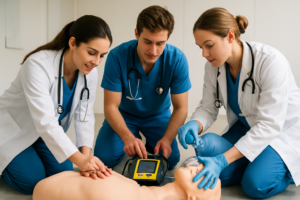
When someone is in cardiac arrest, their heart is not pumping blood. This means the brain and other organs are not getting oxygen. We perform CPR and use an AED to manually pump blood and try to “restart” the heart.
ROSC is the “goal” of CPR. It means the heart has regained a rhythm that is strong enough to pump blood throughout the body without the help of chest compressions.
It is important to remember that ROSC is not the end of the emergency. It is just the beginning of the next phase of saving a life.
How Do You Recognize ROSC?
During a CPR and AED training session, you are taught to keep going until help arrives or the patient wakes up. But in a professional BLS setting, we look for specific signs that ROSC has occurred.
1. A Tangible Pulse
The most obvious sign of ROSC is a pulse. In a healthcare setting, you will check the carotid pulse (in the neck) for no more than 10 seconds during a rhythm check. If you feel a steady, strong pulse, the heart is circulating blood again.
2. Spontaneous Breathing
Sometimes, a patient will start gasping or breathing on their own once the heart starts beating. Be careful, though—”agonal gasping” can happen during cardiac arrest and is NOT a sign of ROSC. True spontaneous breathing is steady and regular.
3. Movement or Waking Up
In some cases, the patient may start to move, groan, or even open their eyes. This is a clear sign that oxygenated blood is reaching the brain.
4. Measurable Blood Pressure
If you are in a hospital or an ambulance, medical teams will use tools to measure blood pressure. A measurable blood pressure reading is a confirmed sign of ROSC.
ROSC in BLS vs. CPR Level C
There is a difference in how we handle ROSC depending on your training level.
- CPR AED Level C: If you are a member of the general public, you usually don’t stop CPR to check for a pulse. You keep going until the AED tells you to stop, the person wakes up, or paramedics take over.
- Basic Life Support (BLS): Healthcare providers are trained to perform “pulse checks” every 2 minutes (usually when the AED is analyzing). This is when they identify ROSC.
If you are a student looking to work in a hospital, you must take the BLS track. You can learn more about the differences in our post on BLS vs. CPR-C.
What Do You Do After ROSC is Achieved?
Achieving ROSC is a huge victory, but the patient is still in a very fragile state. This is called the “Post-Cardiac Arrest” phase. Here is what a first aider or healthcare provider should do:
1. Stop Compressions, But Keep the AED On
If the person has a pulse, you must stop chest compressions. However, do NOT turn off the AED. Keep the pads attached to the patient’s chest. If the heart stops again (which happens often), the AED needs to be ready to analyze and shock immediately.
2. Manage the Airway
Now that the heart is beating, we must ensure the patient keeps getting oxygen.
- Check the ABCs of first aid.
- If the patient is unconscious but breathing, place them in the H.A.I.N.E.S. recovery position to keep their airway clear in case they vomit.
3. Monitor Vitals
ROSC can be lost. You must continue to check the pulse and breathing every minute until the paramedics arrive. If the pulse disappears, you must immediately restart CPR.
4. Provide Rescue Breathing (If Needed)
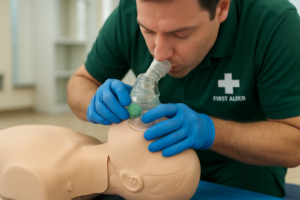
Sometimes the heart starts beating (ROSC), but the patient is still not breathing on their own. In this case, you stop compressions but continue providing “rescue breaths” (1 breath every 6 seconds for adults).
The Importance of Quick Action
The chances of achieving ROSC depend on how quickly CPR started and how fast an AED was used.
- For every minute that passes without CPR, the chance of ROSC drops by about 10%.
- Using an AED within the first 3 minutes of collapse can increase the chance of ROSC by over 70%.
This is why we encourage everyone in our community to take a Standard First Aid course. Whether you are in a first aid course in Surrey or Vancouver, learning to use an AED is the most important skill you can have.
Why Do We Learn This in BLS?
For healthcare providers, ROSC is part of a larger chain of survival. Understanding ROSC helps you transition from “Rescue Mode” to “Supportive Mode.”
In our Vancouver first aid courses, we use high-fidelity mannequins that can actually simulate ROSC. This allows students to practice the feeling of a pulse returning and teaches them to stop compressions instantly to avoid injuring a beating heart.
The ROSC Checklist
| Action | What to do |
| Check Pulse | Every 2 minutes during AED analysis. |
| If Pulse is Present | STOP chest compressions. |
| AED Pads | Leave them ON and connected. |
| Positioning | Move to the Recovery Position. |
| Breathing | If not breathing but has a pulse, give rescue breaths. |
Be Ready for the Save
ROSC is the moment every life-saver works for. It is the moment a person comes back to life. But it requires high-quality CPR, fast AED use, and a clear head.
If you are a healthcare student or a professional needing to renew your skills, don’t wait. Our Basic Life Support classes are designed to give you the confidence to achieve ROSC in a real-world emergency.
Ready to level up your skills?
Check out our Upcoming Course Schedule and sign up for a BLS or First Aid class in Coquitlam, Surrey, Langley, or Vancouver today!
