You love your babysitting days with the grandkids, but there is one thought that keeps creeping in. What would you actually do if your grandchild started choking, right there at the kitchen table, with no parent in the room? That flash of worry is completely normal, and it does not mean you need a full workplace certificate like a daycare worker. In this guide, we will walk through exactly what to do in the moment, and help you choose between a quick refresher class and a full certification, based on how often you babysit.
Grandparents babysitting occasionally do not need a full workplace certificate. A short, hands-on Infant/Child CPR Basics session covers exactly what you need for choking and CPR. If you babysit regularly, watch multiple grandkids, or want a certificate that stays valid for years, an Emergency Child Care First Aid course is the better fit.
Knowing which option matches your situation takes the guesswork out of babysitting days, so let’s look at what each choice actually covers.
Why This Worry Is So Common
Choking is one of the most frightening emergencies a grandparent can imagine, and it is more common than most people realize. Small children explore the world with their mouths, and grape halves, popcorn, hot dogs, and small toys are all common choking hazards in a grandparent’s home. Kitchens, living rooms, and even car seats can hide small objects that a parent-proofed home might have already removed.
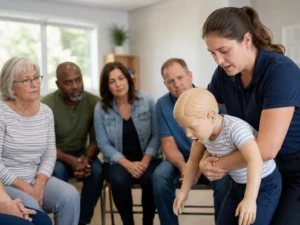
The good news is that choking response is a physical skill, not a medical degree. It takes practice on a mannequin and a clear, memorized sequence of steps, both of which you can learn in a single short class. Once you have practiced it with your hands, the steps tend to stick.
What to Do If Your Grandchild Is Choking
While nothing replaces hands-on training, here is the basic sequence for a choking infant or child so you have a mental picture before your class.
For an infant under one year old:
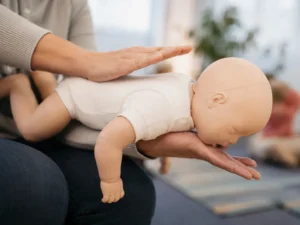
- Support the baby face-down along your forearm, head lower than the chest
- Give five firm back blows between the shoulder blades with the heel of your hand
- Turn the baby face-up and give five chest thrusts using two fingers on the breastbone
- Repeat the cycle until the object comes out or the baby becomes unresponsive
- Call 911 immediately if the baby stops responding
For a child over one year old:
- Ask if they can cough or speak; do not interfere if they can
- If they cannot breathe, cough, or speak, stand behind them and give abdominal thrusts (the Heimlich maneuver)
- Continue until the object clears or the child becomes unresponsive
- Call 911 right away if they lose consciousness
These steps sound simple written down, but the pressure, hand position, and timing are much easier to get right after practicing on a training mannequin with an instructor watching your form.
Do You Need a Full Certificate or Just the Basics?
This is the real question behind most grandparents’ search, and the honest answer depends on how often you are the one in charge.
If you babysit occasionally, on weekends or during school holidays, a short refresher session is usually enough. It gives you hands-on practice with choking response and infant CPR without asking you to sit through a full-day course designed for professional childcare workers. If you are the regular, go-to caregiver several days a week, or you watch multiple grandchildren at once, a full certificate gives you deeper coverage and a document you can keep on file for extra peace of mind.
Option One: Infant/Child CPR Basics
The Infant/Child CPR Basics session is built for exactly this situation. It is a short, focused class that covers choking response and CPR for both infants and children, without the extra content a licensed childcare worker would need. You practice hands-on with real mannequins, ask questions in a relaxed setting, and leave with the confidence to act instead of freeze.
This option works well for grandparents, aunts, uncles, and any family member who wants real skills without a lengthy time commitment. It is knowledge-based rather than a formal workplace certificate, which makes it a comfortable, low-pressure starting point.
Option Two: Emergency Child Care First Aid with CPR/AED Level B
If you want a full Canadian Red Cross certificate that stays valid for three years, Emergency Child Care First Aid with CPR/AED Level B is the stronger choice. This one-day course covers choking, CPR, and AED use for infants and children, plus wound care, poisoning, seizures, and other medical emergencies that can come up during a long babysitting day.
Many grandparents choose this route when they are the primary daytime caregiver while parents work, or when they simply want the deepest level of preparation available. It is also the same certificate childcare professionals use, so it meets a high standard of training.
Grandparent-Friendly Class Features to Look For
When comparing courses in Vancouver or Surrey, look for a few details that make the experience easier for grandparents specifically.
- Hands-on practice, not just a video: You want real mannequin practice, not a passive lecture
- A relaxed, judgment-free classroom: A good instructor welcomes questions from every generation, not just new parents
- Realistic scenarios: Look for training that covers common household hazards, not just workplace situations
- A manageable time commitment: Choose a length that fits your schedule, whether that is 90 minutes or a full day
If you are unsure which course fits your family, our guide on which first aid course parents need for babies and toddlers breaks down the differences in more detail, and applies just as well to grandparents.
Beyond Choking: Other Emergencies Grandparents Should Know
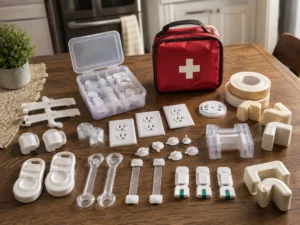
Choking gets the most attention, but a few other situations come up often enough to be worth learning too. Falls from furniture, minor burns from a hot stove or bath, and allergic reactions to new foods are all common at a grandparent’s house, especially if childproofing is less strict than it is at home. A short class or a full certification course will cover these situations alongside choking and CPR, so you are prepared for more than one type of emergency.
Our article on CPR basics for parents is another helpful read if you want to understand the reasoning behind each CPR step before you attend a hands-on class.
Frequently Asked Questions
Do grandparents need a certified first aid course to babysit?
No. Grandparents babysitting occasionally do not need a formal workplace certificate. A short, hands-on Infant/Child CPR Basics session covers choking and CPR skills without requiring a full-day course.
What should I do if my grandchild is choking and cannot cough or cry?
Call 911 immediately if the child cannot breathe, cough, or speak. For an infant, alternate back blows and chest thrusts. For a child over one, use abdominal thrusts until the object clears or emergency help arrives.
What is the difference between Infant/Child CPR Basics and Emergency Child Care First Aid?
Infant/Child CPR Basics is a short, hands-on session focused on choking and CPR, with no formal certificate. Emergency Child Care First Aid with CPR/AED Level B is a full one-day course that includes a three-year Red Cross certificate and covers a wider range of medical emergencies.
How long does it take to learn infant CPR and choking response?
A focused Infant/Child CPR Basics session typically takes about 90 minutes. A full Emergency Child Care First Aid certification course runs closer to a full day, since it covers a broader range of topics.
Is a first aid class for grandparents different from one for new parents?
The core choking and CPR skills are the same. Many classes are designed to welcome parents, grandparents, and other caregivers together, so you are learning alongside people in a similar caregiving role.
Peace of Mind Is the Real Certificate
Every grandparent wants those babysitting afternoons to be full of giggles, not worry. Learning what to do if your grandchild chokes does not require becoming a medical professional. It just requires a few hours of hands-on practice so your hands know what to do before your mind has to think about it.
At Primary Care First Aid, we welcome grandparents into every class we teach across Vancouver and Surrey, whether you choose the quick basics session or the full certification course. Book the option that fits your family, and walk into your next babysitting day with real confidence instead of quiet worry.
